
Montgomery County City Directory Holdings
Montgomery County has a directory trail, not one complete online shelf. The Brown Harvey Sr. Genealogy Room at Clarksville-Montgomery County Public Library, often called CMCPL, is the local starting point for directories, microfilm, historical newspapers, databases, and death-certificate research. FamilySearch provides a broad United States city and business directory collection, while Ancestry's Montgomery locality page specifically identifies a Clarksville Directory for 1895. Neither online description proves a complete Clarksville run. Ask library staff for the exact title, publisher, year, and whether the volume is on a shelf, microfilm reel, or a database before planning a year-by-year search.
| Collection | Years | Where held | Access |
|---|---|---|---|
| Clarksville and Montgomery historical directories | 19th- and 20th-century runs; exact local list needs staff confirmation | CMCPL Genealogy Room | Ask for shelf, microfilm, or database availability |
| Clarksville Directory | 1895 named collection | Ancestry Montgomery locality collection | Library or subscription access may apply |
| U.S. city and business directories | About 1749-1990 | FamilySearch | Online collection; image and account conditions vary |
| Historical newspapers and obituary leads | Library-specific runs | CMCPL Genealogy Room and licensed databases | Microfilm, database, or staff-assisted research |
A missing year is not proof that a household vanished. A volume may never have been issued, may not cover the needed place, or may be held in a format not described online. Preserve the volume title and the year consulted so the next search does not mistake an access gap for a family fact.
Montgomery County Directory Help at CMCPL
The CMCPL Genealogy Room is the best local place to resolve a directory question that a web search leaves open. Brown Harvey Sr. Genealogy Room holdings include microfilm, historical newspapers, death certificates, Tennessee and regional material, online databases, and genealogy classes. Information Services can be reached at 931-648-8826. The Main Library is at 350 Pageant Lane, Suite 501, and the North Branch is at 435 Jordan Road. A free library card and onsite database access can also help when a licensed collection is unavailable at home.
The library's own history adds context to the collection: it began in a courthouse office in 1894, and the North Branch opened in 2025 as the first branch in 130 years. That long local role makes the library a sensible place to compare a directory address against a newspaper notice or obituary rather than treating one index line as a final answer.
The Genealogy Room source page describes the local research services represented in this Montgomery County city directory image.
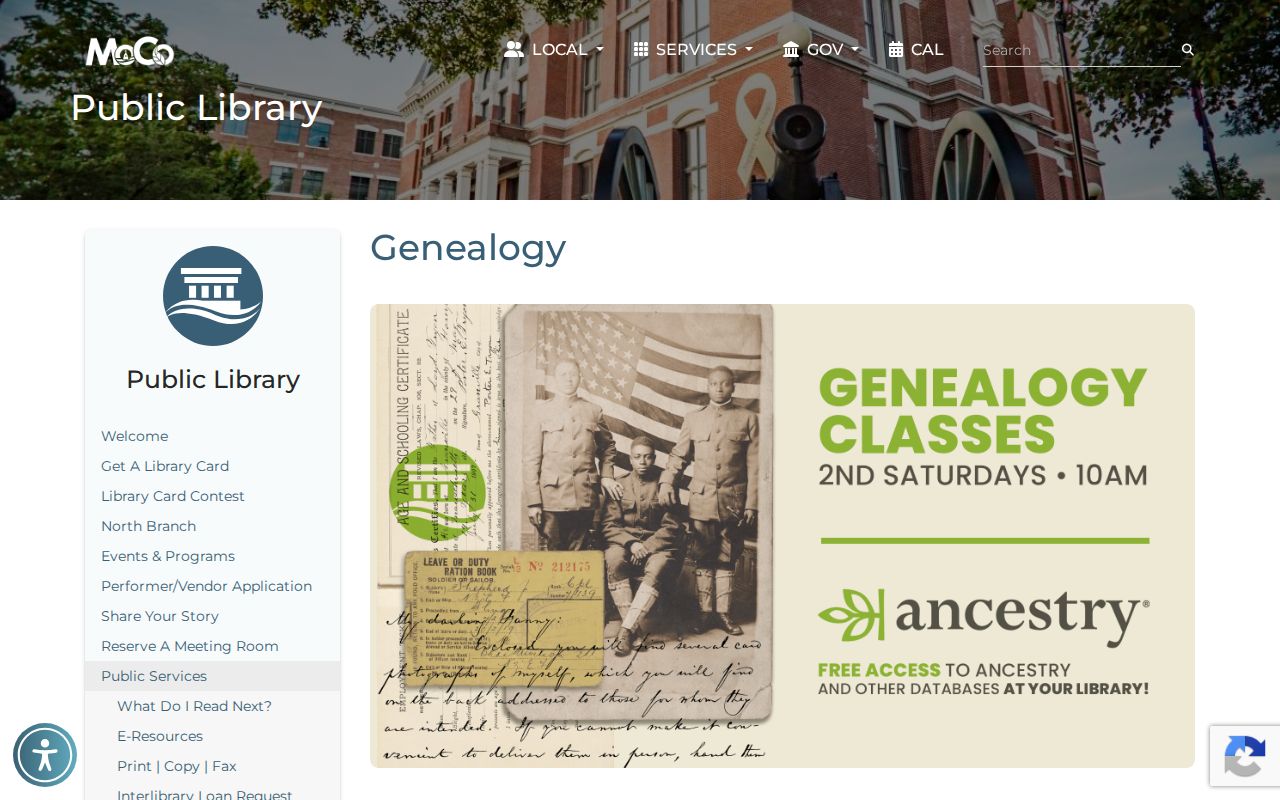
The room is a practical fallback for a date, spelling, or address that is not visible in an online result.
Clarksville Directories Need Volume Checks
Catalog labels can make a broad directory collection look more complete than it is. FamilySearch describes its nationwide U.S. City and Business Directories collection as covering about 1749 through 1990, but that range belongs to the collection as a whole. Ancestry identifies Clarksville Directory 1895, along with other Montgomery research collections. Those facts are useful leads, not a promise of an uninterrupted local sequence or a complete reverse-directory series.
Search each name in several forms. Initials, middle names, a married or former surname, an estate representative, and spelling variants can divide one household across indexes. When a result is absent, record the title searched and try a nearby year, a newspaper, or a family collection before drawing a conclusion. The library's database-by-title page identifies Ancestry Plus Library Edition and Tennessee electronic and newspaper resources that can provide a different route.
Note: Directory availability is publisher-dependent, so staff confirmation is more reliable than an assumed local year run.
Reading Montgomery County Directory Entries
A historical volume is a dated snapshot. Depending on the publisher and year, an entry can name a person, list a street address, identify a household relationship, note an occupation or business connection, and use short notations about ownership or boarding. The abbreviation key in the front or back of the same volume matters. It explains the local shorthand and prevents a reader from turning a printer's code into a larger claim than the page supports.
| Name form | The spelling, initials, or married-name form printed for that year. |
|---|---|
| Address | A dated street and number, which may need later numbering or street-name normalization. |
| Relationship clue | A household reference or other family notation when the publisher included one. |
| Occupation or business label | A period description that can distinguish people with the same name. |
| Printed notation | A publisher-specific ownership, boarding, or other abbreviated mark that must be read with its key. |
- Criss-cross directory
- An address-ordered section that works from a street location toward a listed household or business.
- Householder index
- A list organized around the person identified as the household contact, not a full account of every resident.
- Abbreviation key
- The volume's explanation of its short printed codes; photograph or note it before interpreting an entry.
Even a clear entry does not establish a present address, daily occupancy, or a complete household. It records what the directory publisher chose to print at that historical point.
Montgomery County Directories and Newspapers
Directory research gets stronger when a name and address are checked against another dated source. CMCPL's historical newspapers, microfilm, and databases can supply an announcement, move, death notice, church reference, or business mention near the directory year. Ancestry's locality page names a Montgomery obituary collection for 1911-2009, though its exact newspaper coverage and access should be checked through the library account. An obituary is a useful relationship or address clue, not a certified death record.
For a person who disappears from a directory, compare the last listed address with a newspaper, cemetery evidence, a death certificate when access rules allow, or an Archives probate record. That comparison separates a possible move from a death, a missed listing, or a name change. It also keeps an address associated with the right date.
Montgomery County Historical Society Referrals
The Montgomery County Historical Society, formed in 1924, publishes the Cornsheller newsletter and supports local and family-history interest. Its role is important but narrow: the society says it has no research library and refers researchers to the County Archives and CMCPL Genealogy Room. Use it for referrals, local-history context, and leads to a family or community story, rather than as a searchable list of present-day people.
The Historical Society source page provides the referral and local-history context shown in this directory-research image.
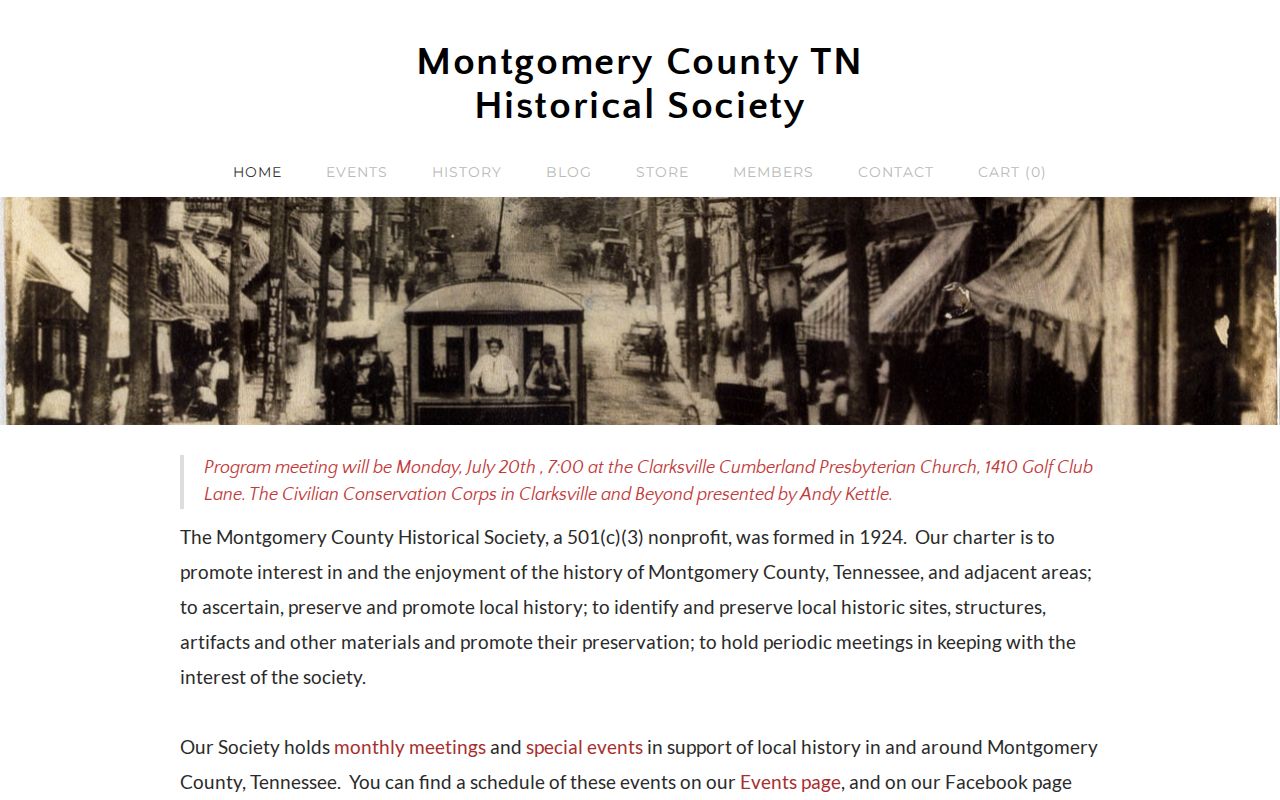
A society referral can point a directory researcher to the archive volume, library desk, or community history most likely to explain a name.
Maps for a Clarksville Directory Address
When a directory gives a street number but the modern block is confusing, use maps as historical context. The 1877 Library of Congress Montgomery County map names landowners, roads, railroads, property tracts, and town insets. It can connect a name to a tract or road, but it is not a current parcel layer. Treat spellings and boundaries on that map as period evidence, then compare them with deed books or other dated records.
The 1903 Clarksville Sanborn map set contains 19 sheets. Its building footprints, materials, lot context, and street geometry can help determine whether a structure or block existed in the directory period. Sanborn sheets do not create a modern occupant list. They show the built setting that can make an old address more understandable.
Note: Keep the map year beside each address because a tract, street form, and building layout can change.
Follow a Montgomery County Directory Household
Use the annual directory sequence to trace a household through time rather than to make one large leap from a single entry. Start with the exact name form, address, and year. Then preserve the changes: a new street, a different spelling, a relationship note, or a business label may identify the next record family to search. Pairing directory years with the available census schedule and local newspaper sources is especially useful for the years between census enumerations.
- Find the earliest reliable directory entry and write down the full printed name, address, year, and title.
- Check nearby volumes for the same person, initials, married names, and spelling variants.
- Compare each address change with a newspaper, map, deed, or assessment clue from the same period.
- Pair the household with the relevant census schedule, keeping the census date separate from the directory publication date.
- Use probate, cemetery, obituary, or Archives material to test a disappearance, inheritance, or family relationship.
The County Archives can supply the deeper record layer, including probate records from 1796-1990 and deed books from 1788-1997. Annual registration and photo identification are required there, and the reading room uses closed stacks, sign-in procedures, and advance pull timing. Those rules make it worth planning the requested record group before a visit.
Montgomery County Directories Give Dated Clues
A directory volume can connect a name, address, relationship, or occupation to a particular year. It cannot establish that the person still lives there, that every household member was listed, or that the address carried the same number later. A tax owner, deed party, or business address may also be different from the person who occupied the location. Treat each entry as a lead that needs a second source with its own date and purpose.
Myth: a historical directory result proves a current resident. It does not. A responsible check keeps the source date visible, distinguishes a historical address from a current parcel record, and stops when a record is protected or too incomplete to support the claim. For a present-day identity question, use the narrower verification routes described on the Montgomery County resident lookup page.